
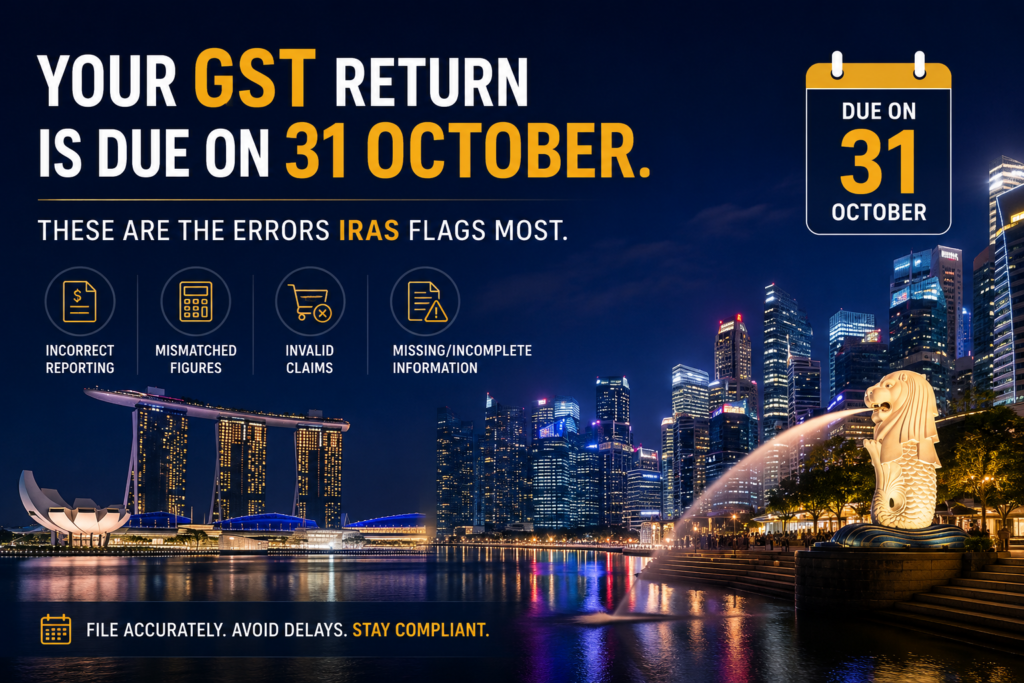
Your GST Return Is Due on 31 October. These Are the Errors IRAS Flags Most.
First, one urgent housekeeping note from last week’s topic. IRAS has confirmed the payment-channel cut-offs for the SME Cash Grant 2026: businesses with an existing GIRO arrangement as at 14 October, or with PayNow Corporate registered by 25 October 2026, will receive the grant in their bank account from 2 November. No cheques will be issued, and the grant cannot be paid to a third party. The GIRO date has passed — so if your business has no GIRO arrangement with IRAS and no PayNow Corporate linked to its UEN, registering PayNow Corporate with your bank by this Sunday is the difference between receiving the grant on time and chasing it later. IRAS’s eligibility checker is now live on its website.
Now to this week’s main event. For GST-registered businesses in Singapore on standard quarterly accounting, the GST F5 return for the July–September quarter is due by 31 October — ten days from today — together with payment of any net GST owed.
The F5 looks like a simple form: a dozen boxes, mostly totals. That simplicity is deceptive. GST is a self-assessed tax filed four times a year, which means small recurring errors compound quickly — and IRAS’s systems cross-check F5 data against income tax filings, customs records and InvoiceNow transmissions more systematically every year. The errors that get flagged are rarely exotic. They are the same handful, quarter after quarter, business after business.
Here is how to file this one correctly — and the mistakes worth checking for before you submit.
The Mechanics, Briefly
Every GST-registered business must file the F5 within one month of the end of each accounting period — for a standard quarter ended 30 September, that means 31 October. The return reports your output tax (the 9% charged on your standard-rated supplies) against your input tax (the 9% paid on qualifying business purchases), and you pay or receive the net difference. Payment is due by the same deadline; businesses on GIRO have the deduction taken automatically after filing.
Two ground rules that still catch people:
A nil return is still a return. No transactions this quarter, dormant trading, nothing to claim — the F5 must still be filed, as a nil return, by the deadline. Not filing because “there was nothing to report” is a late return, with the same penalties.
The penalties are mechanical. A late F5 attracts an immediate S$200 penalty, growing by S$200 for each completed month outstanding, capped at S$10,000 per return. Late payment separately attracts a 5% penalty on the unpaid tax, with an additional 2% per month if the tax is still unpaid 60 days later, capped at 50% of the unpaid tax. Like ACRA’s late-filing regime, none of this involves discretion or warning letters — it runs off the calendar.
The Errors IRAS Flags Most
1. Claiming input tax on the disallowed list.
Certain expenses are blocked from input tax claims by regulation, no matter how genuinely business-related they are. The recurring offenders:
- Private motor cars — the purchase, rental, and running costs (petrol, parking, repairs) of S-plated cars are disallowed, full stop. This is the single most common wrongful claim in SME returns.
- Club subscription fees — joining fees and subscriptions for recreational or sporting clubs, even when used for client entertainment.
- Medical expenses and medical or personal accident insurance for staff — disallowed except where obligatory under the Work Injury Compensation Act or a collective agreement.
- Family benefits — expenses for employees’ family members.
A bookkeeper coding every receipt’s GST into the claimable pile will sweep these in. The fix is a chart of accounts that routes disallowed categories away from input tax by default — set up once, correct forever.
2. Claiming without a valid tax invoice.
Input tax may only be claimed when you hold a valid tax invoice (or simplified tax invoice for amounts up to S$1,000) from a GST-registered supplier, for goods or services used in your business. Three sub-errors live here: claiming off a quotation, delivery order or statement rather than the tax invoice; claiming on purchases from suppliers who are not GST-registered (no GST was charged, so there is nothing to claim — check the invoice actually shows a GST registration number); and claiming the 9% on expenses that never bore GST at all, such as bank charges from exempt financial services. If IRAS asks for the invoice behind a claim and it does not exist, the claim is reversed — with interest on the shortfall.
3. Zero-rating exports without the evidence to support it.
Exports of goods and qualifying international services are zero-rated — 0% GST — which is a benefit, not a default. To zero-rate a goods export you must hold the required export evidence (bills of lading, air waybills, export permits and the commercial documents tying them together) within 60 days of the supply. No evidence in time means the supply should be standard-rated at 9% — out of your own pocket if you never charged the customer. Exporters should treat the document trail as part of the sale, not an afterthought; a quarterly check that every zero-rated line has its evidence on file is cheap insurance.
4. Getting the timing wrong.
GST is accounted for by reference to the time of supply — generally the earlier of invoice date or payment received — not by when your bookkeeper processes the paperwork. The classic quarter-end errors: September invoices keyed in October and reported a quarter late, deposits received but not reported until the final invoice, and credit notes netted off informally rather than adjusted properly. Each is individually small; across a year they produce exactly the pattern of mismatch between your GST returns and your income tax filing that invites an IRAS query.
5. Forgetting output tax on fringe benefits and own use.
Give away goods you claimed input tax on — hampers to clients, stock for personal use, gifts to staff above the S$200-per-gift threshold — and output tax is generally due on the deemed supply. Businesses remember the claim and forget the give-back.
6. Missing the reverse charge on imported services.
Businesses that are not entitled to full input tax credit (because they make exempt supplies — common for those with financial or residential property income) must account for GST on imported services under the reverse charge regime. Fully taxable businesses are largely unaffected, but partially exempt ones that pay overseas head-office charges, offshore professional fees or foreign software licensing frequently miss this entirely. If your business has any exempt income and any overseas service spend, this deserves one deliberate check with your accountant.
Found an Error in a Past Return? Fix It the Cheap Way
Discovering a mistake in a previously filed F5 is common, and Singapore’s system is genuinely forgiving to those who correct promptly — and genuinely expensive to those who wait for IRAS to find it.
The small-error concession. If the net GST error is S$3,000 or less, and the total non-GST amounts in error are within 5% of the total supplies declared in the affected return, you may simply adjust it in your next F5 — no separate disclosure, no penalty. Most routine errors fall here, which is itself a reason to review returns regularly: caught early, the fix is a line in next quarter’s return.
Larger errors: file a GST F7. Errors beyond the concession thresholds are corrected by filing a GST F7 for the affected period. Under IRAS’s Voluntary Disclosure Programme, errors disclosed within the one-year grace period from the statutory filing deadline attract no penalty at all; disclosures after the grace period attract a reduced flat penalty of 5% of the tax undercharged — against the up-to-200% penalties available where IRAS uncovers the error itself. The arithmetic of coming forward is not close.
The discipline that makes all of this painless is unglamorous: a quarterly reconciliation of the GST return to the accounts before filing, so errors surface at S$300, not S$30,000.
A Pre-Filing Checklist for 31 October
- All September-quarter sales invoices captured and reported in the correct period — including deposits received
- Input tax claims checked against the disallowed list (motor cars, club subscriptions, staff medical, family benefits)
- A valid tax invoice on file for every claim; no claims against non-GST-registered suppliers
- Every zero-rated export line supported by export evidence obtained within 60 days
- Credit notes and bad-debt relief adjustments properly reflected
- Output tax accounted for on gifts and deemed supplies where required
- If partially exempt: reverse charge on imported services considered
- Return reconciled to the accounting system before submission — not after
- Filed via myTax Portal and payment arranged (or GIRO confirmed) by 31 October — nil return filed if there is nothing to report
- And separately, by 25 October: PayNow Corporate registered if your business has no GIRO with IRAS and may be eligible for the SME Cash Grant
Calibrated, as Always
Must do: file the F5 and pay by 31 October — the S$200-per-month and 5%-plus-2% penalties are automatic. If you have no valid payment channel with IRAS, register PayNow Corporate by 25 October for the cash grant.
Worth doing this quarter: run the disallowed-list and tax-invoice checks above before submitting; if you find past errors within the S$3,000 concession, fold the fix into this return.
Merely possible, not urgent: a full historical GST review. It earns its cost mainly for businesses with exports, exempt income, or a history of DIY bookkeeping — if that is you and the returns have never been professionally reviewed, the one-year VDP grace window is the reason to do it sooner rather than later.
How A1 Accounting Helps
GST filing accuracy is a bookkeeping property before it is a tax property. For our clients on Xero, the quarter’s output and input tax accumulate correctly as transactions are recorded — disallowed categories coded out by default, tax invoices attached digitally, export documentation filed against the sale — so the F5 is a review-and-submit exercise, not a quarterly reconstruction. We prepare and file the return, manage the GIRO cycle, and where a past error surfaces, we handle the F7 or concession adjustment and the voluntary disclosure so the penalty outcome is the best available.
If your September-quarter return is not yet in hand — or you have a quiet suspicion about past ones — ten days is enough time to do this properly. Next week is not.
📞 Call or WhatsApp: +65 8066 2238 (also available on WeChat, Line & Telegram)
📧 Email: [email protected]
🌐 Visit us at: acrafilingagent.com
📍 63 Jln Pemimpin, #02-03 Pemimpin Industrial Building, Singapore 577219
F5 due 31 October. PayNow Corporate by 25 October. Both are this-week problems — reach out today and we will take them off your plate.
Disclaimer: This article is for general informational purposes only and does not constitute tax advice. GST treatment, input tax claim conditions, error-correction concessions and penalty outcomes depend on individual circumstances and current IRAS rules. Consult a qualified professional and refer to IRAS at iras.gov.sg before acting.*