
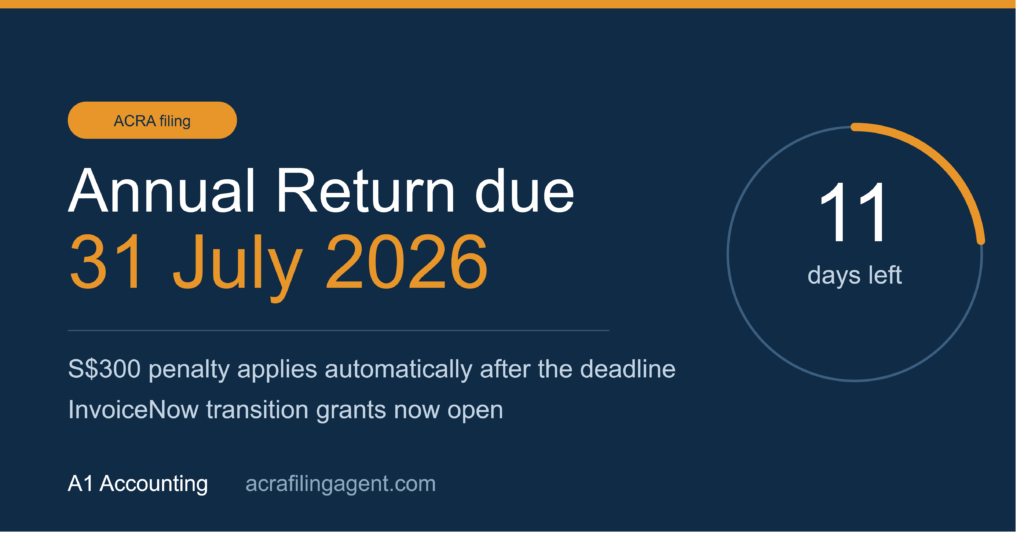
Your Annual Return Is Due in 11 Days. And There Is New Grant Money on the Table.
Two things are happening right now that every Singapore company director should be aware of.
The first is urgent: if your company’s financial year ends on 31 December 2025, your Annual Return must be filed with ACRA by 31 July 2026. That is 11 days from today. The window for an Extension of Time has already closed. If you have not started, you need to file this week.
The second is an opportunity: the GST InvoiceNow Transition Grants opened on 1 July 2026. SMEs can now claim a cash grant of up to S$1,000 to offset the costs of adopting InvoiceNow-ready software. Larger businesses can claim up to S$5,000. These grants are available until fully claimed — and based on how quickly earlier government grants have been exhausted, waiting is a risk.
This article covers both in full.
Part One: The Annual Return Deadline Is 31 July 2026.
What the Annual Return Is
The Annual Return (AR) is a mandatory statutory filing that every Singapore-incorporated company must submit to ACRA each year through the BizFile portal. It updates the public register with your company’s current information: directors, shareholders, registered office address, share capital, and financial statements.
The AR is not the same as your corporate income tax return, which is filed with IRAS. The AR is an ACRA obligation under Section 197 of the Companies Act 1967. Both must be filed — they are separate requirements with separate deadlines.
Every company must file its AR — including dormant companies and companies that made no revenue during the year. There are no exceptions based on company size, trading status, or industry.
The Deadline for December FYE Companies
For private companies with a financial year end of 31 December 2025, the AR must be filed within seven months of financial year end — which means by 31 July 2026.
This deadline is strict. From 2026, ACRA removed any informal grace period that previously existed. If your deadline is 31 July and you file on 1 August, the S$300 late penalty is applied automatically through BizFile at the point of submission. There is no buffer, no warning, and no discretion. The penalty is:
- S$300 if filed within three months after the deadline (i.e. between 1 August and 31 October 2026)
- S$600 if filed more than three months after the deadline (i.e. from 1 November 2026 onwards)
Beyond the financial penalty, repeated late filings carry escalating consequences — composition sums, court prosecution, director fines of up to S$5,000 per charge, and potential disqualification. Three consecutive late Annual Returns is one of the recognised triggers for ACRA-initiated director disqualification under Section 155 of the Companies Act.
For companies with a financial year end other than December — such as 31 March, 30 June, or 30 September 2026 — your deadline falls seven months after your respective FYE. The same rules apply.
What Needs to Be Ready Before You File
The AR is submitted through BizFile. Most company information is pre-filled from your previous filing, which means errors in your current ACRA records carry through to your AR — and an AR submitted with incorrect information is still a compliance breach, even if unintentional.
Before filing, confirm the following are accurate in ACRA’s system:
Company information — registered office address, business activities (SSIC codes, which were migrated to SSIC 2025 on 9 May 2026), and company type. If your SSIC code was not reviewed or corrected after the migration, do that before filing your AR.
Director and secretary details — names, identification numbers, residential addresses, and appointment dates for all current directors and your company secretary. If there have been any changes in the past twelve months that were not lodged with ACRA at the time, correct them before filing.
Shareholder and share capital details — current shareholders, number of shares held, issued share capital, and paid-up capital. Any share transfers or allotments that occurred during the financial year must be reflected.
AGM status — you must declare in the AR whether an AGM was held, whether it was dispensed with by a duly passed resolution, or whether your company is exempt. Private companies can dispense with holding an AGM if all members pass a dispensation resolution, or if financial statements were sent to all members within five months of the financial year end. If you held an AGM, confirm the date and that the required notice period was met.
Financial statements — most private companies must attach financial statements to the AR. Small companies that qualify for audit exemption may file unaudited statements. Companies that have qualified as Exempt Private Companies (EPCs) and meet the relevant criteria may file a solvency declaration instead of full financial statements. Where financial statements must be filed, most private companies are required to submit them in XBRL format through ACRA’s BizFinx Preparation Tool alongside a PDF copy.
The Extension of Time Window Has Closed
An Extension of Time (EOT) of up to 60 days can be requested from ACRA at a non-refundable fee of S$200 per application. However, an EOT application must be submitted at least 14 working days before the deadline. For a 31 July 2026 deadline, that window closed in early July.
If you are reading this on or after 20 July 2026 and have not already applied, an EOT is no longer available to you. Filing on time is the only way to avoid the penalty.
What Happens if You Miss the Deadline
ACRA’s escalation process works as follows. Late penalties apply automatically at the point of filing. For more serious or persistent cases, ACRA may issue a notice requiring compliance, then offer a composition sum to settle the matter without court proceedings. If the composition sum is not paid or ACRA decides the case warrants prosecution, a court summons is served to the director’s residential address. Attendance is mandatory. Failing to appear results in a warrant of arrest.
For companies that persistently fail to file ARs for multiple consecutive years, ACRA will initiate striking off — removing the company from the register entirely — which triggers its own set of complications for directors, shareholders, and any ongoing business activities.
None of this is unusual or theoretical. ACRA processes several thousand late filing cases annually. The enforcement machinery is not discretionary — it runs systematically off filing records.
Your Checklist for the Next 11 Days
- [ ] Confirm your company’s financial year end and verify the exact AR deadline
- [ ] Log into BizFile and review all pre-filled company information — correct anything that is inaccurate before proceeding
- [ ] Check that your SSIC code has been correctly migrated to SSIC 2025; update if not
- [ ] Confirm your AGM has been held, dispensed with, or that your company qualifies for exemption
- [ ] Ensure financial statements are prepared and in the correct format — unaudited for qualifying small companies, audited where required, in XBRL format where applicable
- [ ] File the AR via BizFile before 31 July 2026, paying the S$60 filing fee
- [ ] If your records need correcting first, start today — corrections take time and the EOT window has closed
Part Two: The GST InvoiceNow Transition Grants Are Now Open.
What Changed on 1 July 2026
On 1 July 2026, three new InvoiceNow-related cash grants became available. These are separate from and in addition to the free InvoiceNow-Ready Solution access that IMDA has made available for SMEs.
Grant 1 — InvoiceNow Transition Grant for SMEs
Available to: GST-registered businesses with total annual supplies of S$4 million or less.
Amount: S$1,000 cash grant to offset the cost of subscribing to an IMDA-accredited InvoiceNow-Ready Solution Provider (IRSP) or connecting via an accredited Access Point.
Available from: 1 July 2026 to 31 March 2030, or until fully claimed.
Grant 2 — InvoiceNow Transition Grant for Larger Businesses
Available to: GST-registered businesses with total annual supplies exceeding S$4 million.
Amount: S$5,000 cash grant to offset the cost of connecting to InvoiceNow via an IMDA-accredited Access Point.
Available from: 1 July 2026 to 31 March 2028, or until fully claimed.
Grant 3 — InvoiceNow Queen Bee Grant
Available to: Large enterprises that integrate their ERP systems with InvoiceNow and drive adoption across their business ecosystem — for example, requiring or supporting their suppliers or customers to adopt InvoiceNow.
Amount: Up to S$25,000.
Eligible businesses are expected to commence integration by 1 July 2026 and complete it by 31 March 2030.
Why the “Until Fully Claimed” Condition Matters
Each of these grants is available until the allocated funding pool is exhausted, not simply until the date stated. Previous government grant pools for digital adoption — including earlier PSG funding tranches — have been claimed out faster than expected. The S$1,000 SME grant in particular is likely to see high uptake given the wide eligibility base.
Three weeks into the claim window, the funding is still open. Claiming early is straightforwardly better than waiting.
Who Qualifies and How to Claim
The grants are administered by IMDA. To qualify, your business must be GST-registered. For the SME grant, your total annual supplies must not exceed S$4 million. You must subscribe to or connect via an IMDA-accredited InvoiceNow solution.
IMDA’s accredited InvoiceNow-Ready Solution Provider list is available on its website. Xero — the cloud accounting platform A1 Accounting uses for our clients — is an accredited InvoiceNow-ready solution. For clients already on Xero, the transition to InvoiceNow functionality does not require switching software; it requires enabling and configuring the InvoiceNow features within your existing Xero setup and registering your business on the SG Peppol Directory.
For businesses not yet on an InvoiceNow-ready platform, the S$1,000 grant materially reduces the cost of transition. Combined with the Productivity Solutions Grant (PSG) which covers up to 50% of qualifying software subscription costs, a qualifying SME switching to an IMDA-accredited cloud accounting solution can recover a substantial portion of the adoption cost.
A Reminder: The InvoiceNow Mandate Is Already in Force for New Voluntary GST Registrants
As we covered in our earlier blog on InvoiceNow, the mandate is not a future obligation for all businesses. It is already in effect for new voluntary GST registrants from 1 April 2026. If your business registered for GST voluntarily on or after that date and is not yet using an InvoiceNow-ready solution, you are already in breach.
The phased rollout to all remaining GST-registered businesses proceeds as follows:
- 1 April 2028: New compulsory GST registrants and existing businesses with annual taxable supplies up to S$200,000
- 1 April 2029: Existing businesses with annual supplies up to S$1 million
- 1 April 2030: Existing businesses with annual supplies up to S$4 million
- 1 April 2031: All remaining GST-registered businesses
If your business falls into one of the later waves, your deadline may feel distant. But the transition grant funding will not last until 2031. Businesses that adopt early claim the grants, avoid deadline pressure, and benefit from more efficient GST reporting in the interim.
Your InvoiceNow Checklist
- [ ] Confirm your GST registration status and your total annual supply level
- [ ] Check whether your current accounting software is IMDA-accredited and InvoiceNow-ready
- [ ] If not, identify an accredited solution and obtain a quotation — check whether PSG funding applies before signing any contract
- [ ] Apply for the InvoiceNow Transition Grant through IMDA — do not wait until the funding pool is exhausted
- [ ] Register your business on the SG Peppol Directory to receive your Peppol ID
- [ ] If you are a new voluntary GST registrant from April 2026, verify that your InvoiceNow setup is active and transmitting invoice data correctly
How A1 Accounting Can Help With Both
These two obligations — the Annual Return filing and the InvoiceNow transition — are very different in nature. One is an annual regulatory filing with a hard deadline 11 days away. The other is a technology adoption with grant funding attached. What they share is that both require action now.
At A1 Accounting, we handle Annual Return filings as part of our corporate secretarial service for clients — preparing financial statements, checking all ACRA records for accuracy, handling the BizFile submission, and tracking the deadline so that our clients do not receive automatic penalties. If your AR is due on 31 July and you do not have a corporate secretary or filing agent managing it, get in touch today.
On InvoiceNow, we are a Xero Silver Partner. Xero is an IMDA-accredited InvoiceNow-ready solution. For clients not yet set up on Xero, we handle the migration and configuration. For clients already on Xero, we can help you enable and configure InvoiceNow functionality, register your Peppol ID, and ensure your GST invoicing workflow is compliant. We can also advise on how to apply for the new Transition Grant alongside any applicable PSG funding to minimise your out-of-pocket costs.
If you need both taken care of, we handle both. That is the practical advantage of working with a single provider who covers corporate secretarial, accounting, and cloud accounting setup under one roof.
📞 Call or WhatsApp: +65 8066 2238 (also available on WeChat, Line & Telegram)
📧 Email: [email protected]
🌐 Visit us at: acrafilingagent.com
📍 63 Jln Pemimpin, #02-03 Pemimpin Industrial Building, Singapore 577219
Annual Return due 31 July. InvoiceNow grants now open. Both need action this week — reach out today and we will take care of it.
Disclaimer: This article is for general informational purposes only. Grant details and filing requirements are accurate as of 20 July 2026 based on publicly available ACRA, IRAS, and IMDA sources. Verify current requirements directly with the relevant authorities before acting. This article does not constitute legal, tax, or professional advice.